
Most home cooks roll braciole too thick or skip the browning step — and end up with tough, bland meat that barely absorbs the sauce. The fix is straightforward: pound the beef paper-thin, sear until genuinely dark, and let it braise long enough that a fork slides in with no resistance. Not by the clock — by feel.
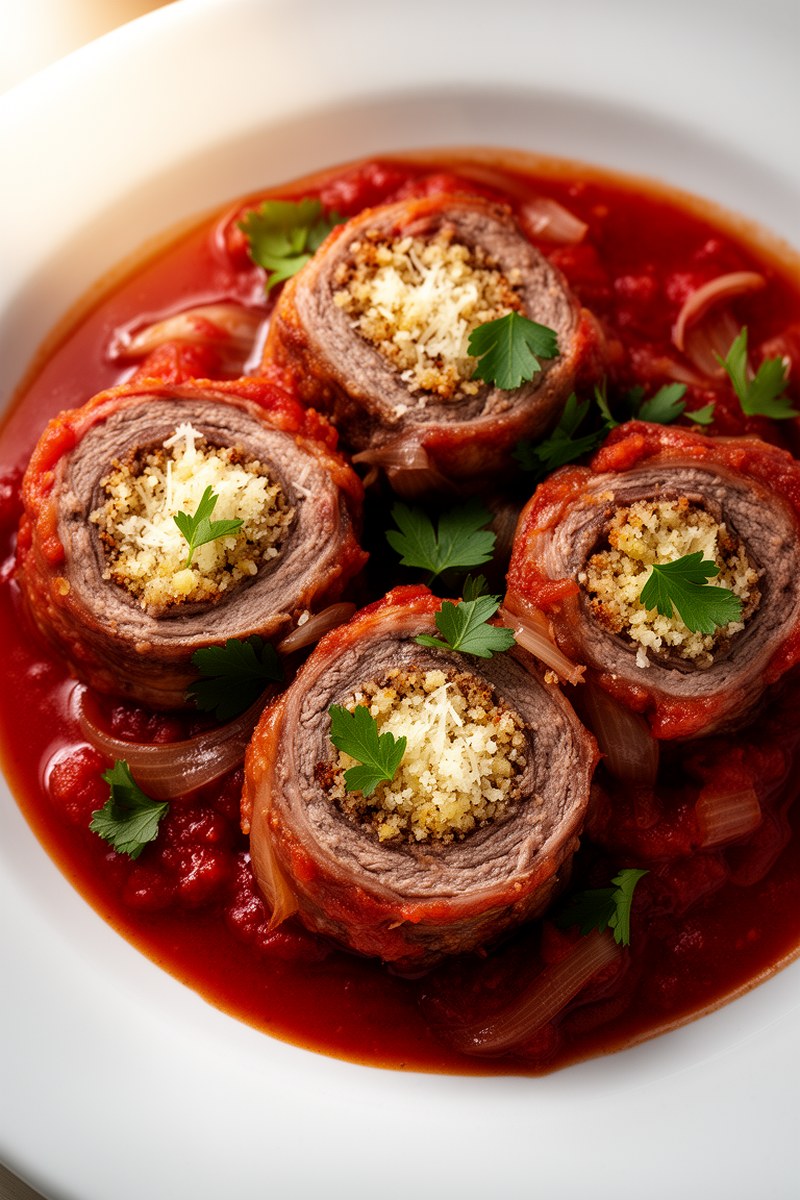
Braciole (bra-CHYO-leh) is one of those dishes that looks complicated but rewards patience more than technique. You start with an inexpensive cut like beef round, fill it with a mixture of breadcrumbs, parmesan, pine nuts, and parsley, roll it tight, then let it simmer slowly in tomato sauce until the meat turns fork-tender and the filling has melted into every slice. Nothing exotic is required — a heavy pan, kitchen twine, and two or three hours on a weekend morning.
This is the Italian-American standard version, not a restaurant shortcut. The Sunday gravy tradition calls for braciole and sausage braised together all morning, with the sauce served first over pasta and the meat following as the second course. You don’t have to go that far, but you’ll want to.
Origins of Braciole
Braciole comes from Southern Italy — Calabria, Campania, and Sicily — where making something substantial from thin, cheap cuts was simply how you cooked. The name derives from braciola, a thin slice of meat cooked over coals. When Southern Italian immigrants arrived in the United States in the late 19th and early 20th centuries, they brought the dish with them. In Italian-American households, braciole became a centerpiece of Sunday gravy: a slow-simmered pot with braciole, meatballs, and sausage, cooked all morning while the family was at church.
The filling varies by region. Neapolitan braciole includes hard-boiled eggs and cured meat. Sicilian versions often add raisins and capers — a sweet-savory contrast that reads as Arab culinary influence from centuries of trade. The recipe here is the Italian-American standard that most people know: breadcrumbs, parmesan, pine nuts, fresh parsley, and garlic.
Ingredients You’ll Need
The most important ingredient is the beef itself. You want top round or beef round steaks — wide, lean, and flat enough to roll. They’re inexpensive and respond well to braising, but they require proper pounding to reach the right thickness. If your supermarket sells them pre-cut but not thin enough, pound them yourself between two sheets of plastic wrap with a meat mallet until they’re about ¼ inch (6mm) thick across the whole surface.
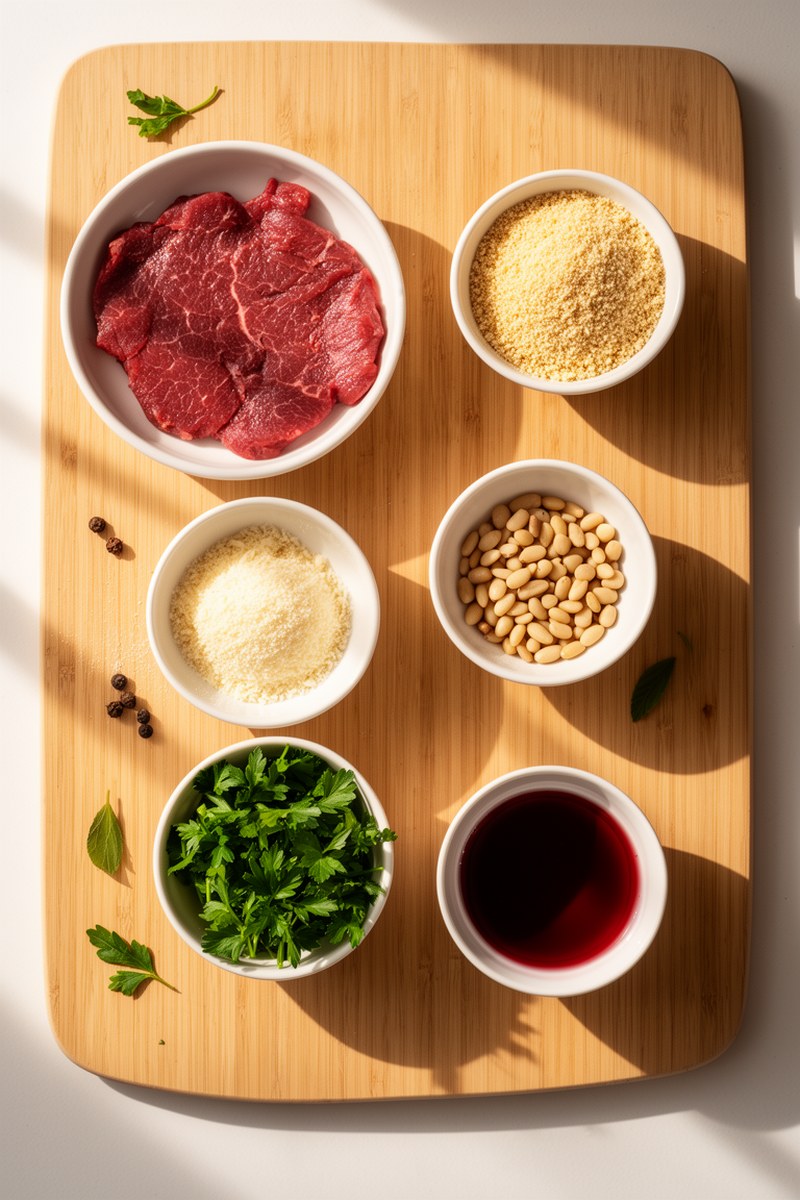
The filling is entirely pantry-based: plain breadcrumbs, finely grated parmesan, toasted pine nuts, flat-leaf parsley, and minced garlic. The tomato sauce for braising should be simple — crushed tomatoes or passata, a splash of dry red wine, a chopped onion, and good olive oil. The meat and the long braise do the flavoring; the sauce doesn’t need embellishment.
Italian Braciole
Ingredients
For the Braciole
- 4 slices beef round steaks about 4 oz each, pounded to ¼ inch thick
- ¾ cup plain breadcrumbs panko or regular
- ½ cup parmesan cheese finely grated
- ¼ cup pine nuts toasted
- 3 tbsp fresh flat-leaf parsley finely chopped
- 3 cloves garlic minced
- 1 tsp kosher salt plus more for seasoning
- ½ tsp black pepper freshly ground, plus more for seasoning
- 2 tbsp olive oil for searing
For the Braising Sauce
- 1 medium yellow onion chopped
- ¾ cup dry red wine or beef broth
- 1 can (28 oz) crushed tomatoes or passata
- 1 tsp salt to taste
Instructions
- Lay each beef round slice between two sheets of plastic wrap. Using the flat side of a meat mallet, pound from the center outward in overlapping strokes until the slice reaches about ¼ inch thick across the entire surface. Work deliberately — the muscle fibers need to stretch evenly without tearing. This is the most critical step; rushes here lead to tough, unevenly cooked rolls.
- Season both sides of each pounded beef slice generously with salt and black pepper.
- In a small bowl, combine breadcrumbs, grated parmesan, toasted pine nuts, chopped parsley, minced garlic, 1 tsp salt, and ½ tsp black pepper. Mix until evenly distributed.
- Lay a pounded beef slice flat on a clean surface. Spread 2 to 3 tablespoons of filling evenly over it, leaving a ½-inch border on all four edges. Do not overfill — the roll must close tightly without bursting during braising.
- Fold the short sides of the beef slice inward slightly, then roll tightly from one long end toward the other, like a burrito. The roll should be snug and compact, not loose or cylindrical.
- Secure each roll with kitchen twine tied at 1-inch intervals along the length. Tie firmly — a roll that comes loose in the pan will scatter the filling into the sauce. Use at least three ties per roll.
- Pat each braciole roll completely dry with paper towels immediately before searing. Surface moisture is the enemy of browning and will cause steaming instead of crust development.
- Heat 2 tablespoons olive oil in a Dutch oven or heavy-bottomed skillet over medium-high heat until the surface shimmers and a drop of water immediately evaporates. The pan must be genuinely hot.
- Add the braciole rolls to the hot pan without crowding — if your pan is small, work in batches. Sear for 2 to 3 minutes on the first side until a deep mahogany brown crust forms. Do not turn early; the crust needs time to develop.
- Turn each roll and sear the second side for 2 to 3 minutes until equally browned. Continue turning and searing all four sides until all surfaces have a deep mahogany crust. Total searing time per batch is 8 to 10 minutes. This browning step builds most of the dish’s flavor and cannot be rushed or skipped.
- Remove the seared braciole rolls from the pan and set aside on a clean plate.
- Reduce the heat to medium. Add the chopped onion to the same pot and cook for 3 to 4 minutes, stirring occasionally, until the onion has softened and begun to turn translucent. Do not brown the onion.
- Pour the dry red wine into the pot and scrape the browned bits from the bottom and sides of the pot with a wooden spoon. These caramelized bits are where the flavor lives — scrape thoroughly and incorporate them into the wine.
- Add the crushed tomatoes to the pot, stir to combine with the wine and onion, and bring to a gentle simmer over medium heat. The sauce should bubble gently, not boil vigorously.
- Return the braciole rolls to the pot, nestle them snugly in the sauce so they are mostly submerged or half-submerged. Cover the pot tightly with a lid (or aluminum foil if you have no lid) and reduce the heat to low.
- Braise covered for 45 to 60 minutes. Turn the rolls once halfway through braising (at about 22 to 30 minutes) to ensure even cooking and sauce absorption.
- Check doneness starting at 40 minutes: pierce the thickest part of one roll with a fork or thin metal skewer. If the fork slides in with zero resistance and the meat feels completely tender, the braciole is done. If it still feels firm, cover and braise another 15 to 20 minutes, then check again. Texture is the signal, not the clock.
- Remove the pot from the heat. Remove all kitchen twine from the braciole rolls before serving or slicing — it can be easy to forget and dangerous to bite into.
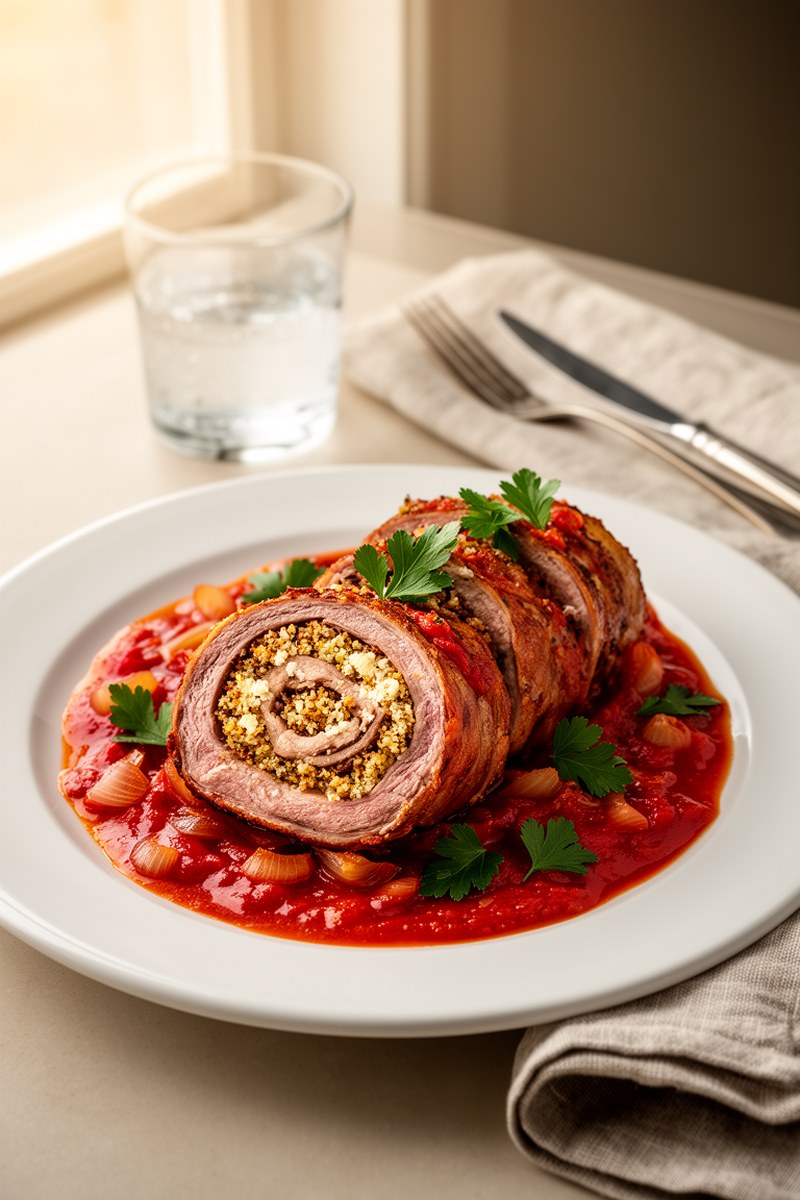
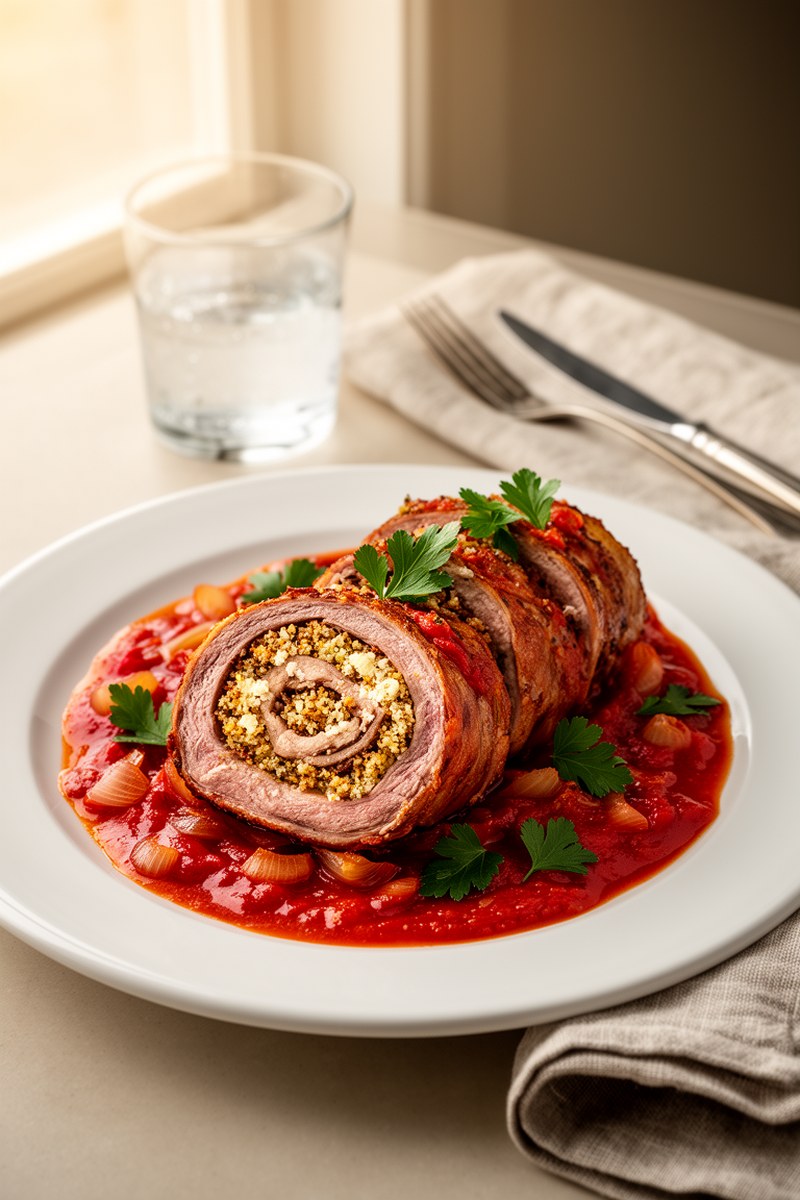
- Serve the braciole whole or sliced into thick rounds. Spoon the tomato braising sauce generously over the top. Each cross-section will reveal the spiral of filling inside.
Notes
How to Make Braciole
Step 1 — Pound the beef thin and season it
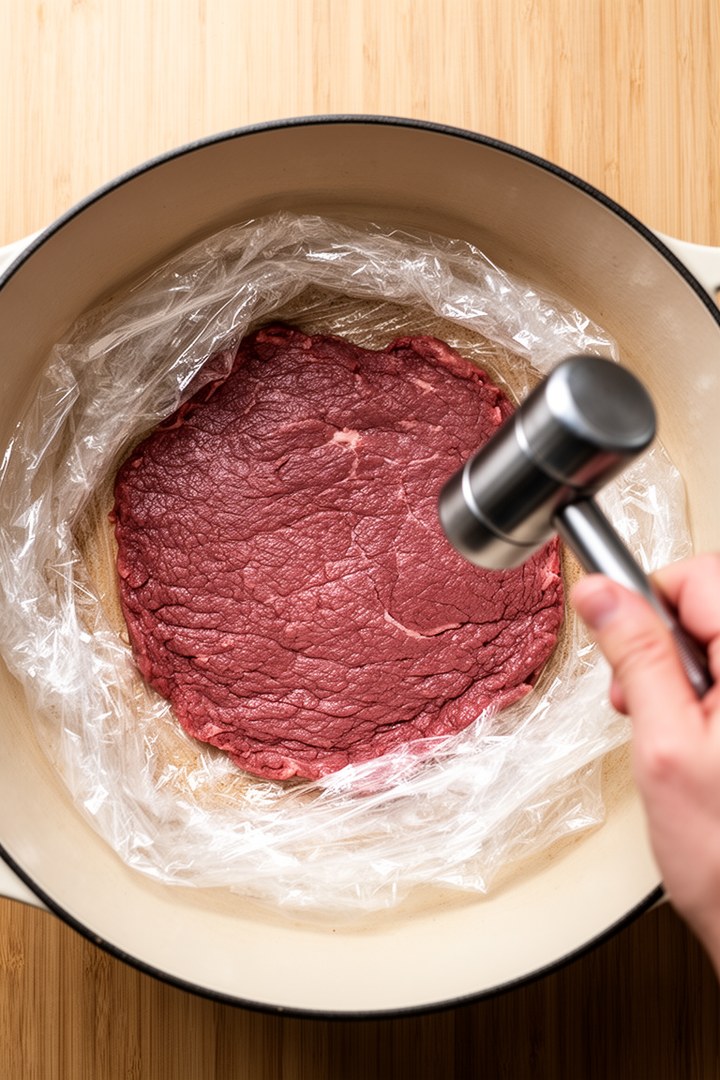
Lay each beef slice between two sheets of plastic wrap and pound with the flat side of a meat mallet until it reaches about ¼ inch (6mm) thick. Work from the center outward in overlapping strokes — this stretches the muscle fibers evenly without tearing holes. Season both sides with salt and black pepper. This is the step most home cooks rush; take your time. A roll that’s too thick in the center will be tough no matter how long you braise it.
Step 2 — Fill, roll, and tie
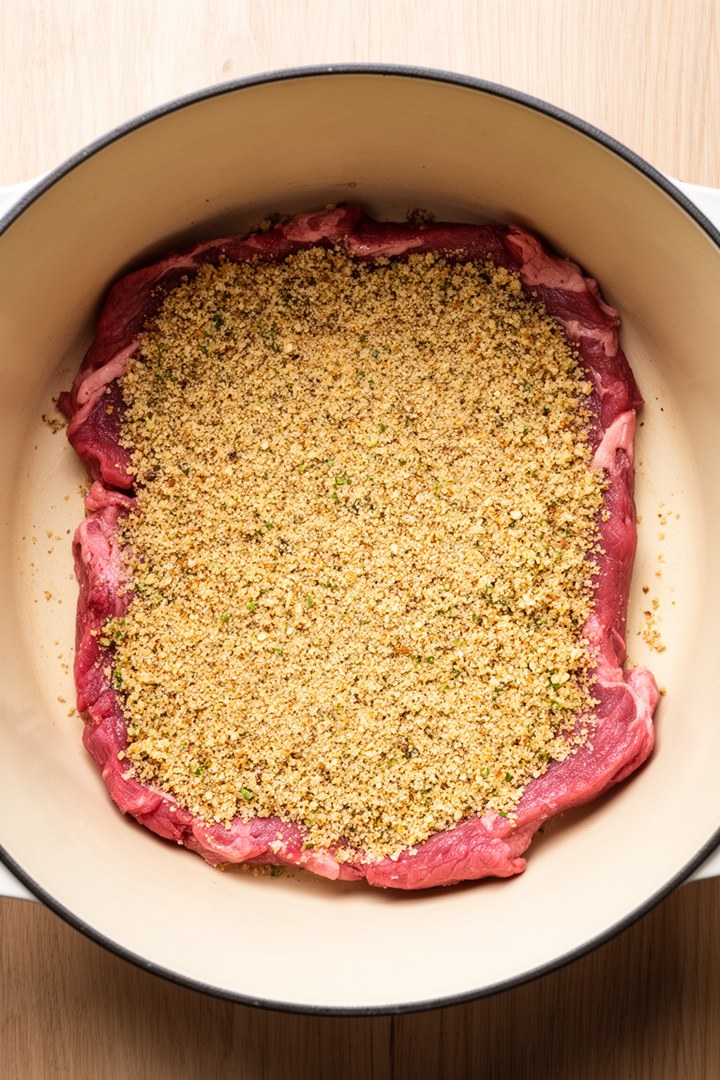
Mix together the breadcrumbs, grated parmesan, pine nuts, chopped parsley, and garlic in a small bowl. Lay a pounded beef slice flat and spread 2 to 3 tablespoons of filling evenly over it, leaving a ½-inch (1.5cm) border on all four edges. Fold the short sides in slightly, then roll tightly from one long end — like a burrito, not a loose cylinder. Secure with kitchen twine at 1-inch (2.5cm) intervals. Tie firmly; a roll that comes loose in the pan scatters the filling into the sauce.
Step 3 — Sear until deeply browned
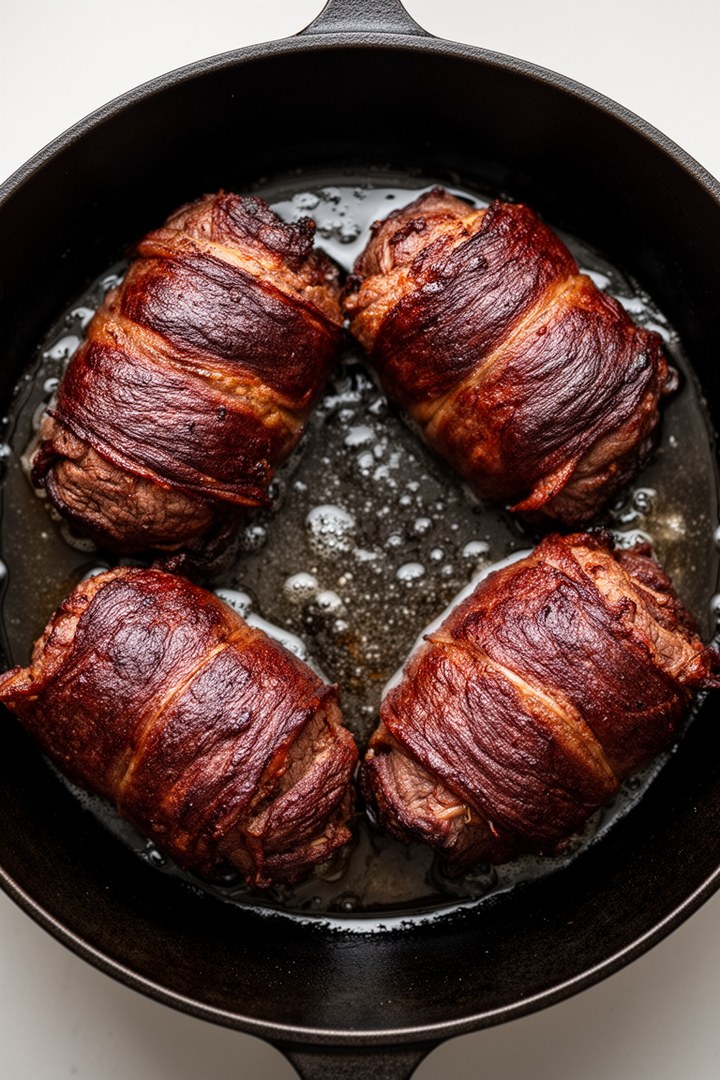
Heat 2 tablespoons of olive oil in a Dutch oven or heavy-bottomed skillet over medium-high heat until shimmering. Pat the braciole rolls completely dry with paper towels — surface moisture is the enemy of browning. Add the rolls without crowding (work in batches if needed) and sear 2 to 3 minutes per side, turning to brown all four sides. The total time is roughly 8 to 10 minutes per batch. You want a deep mahogany crust, not just a pale beige. This step builds most of the dish’s flavor and cannot be skipped or shortened.
Step 4 — Build the sauce and braise
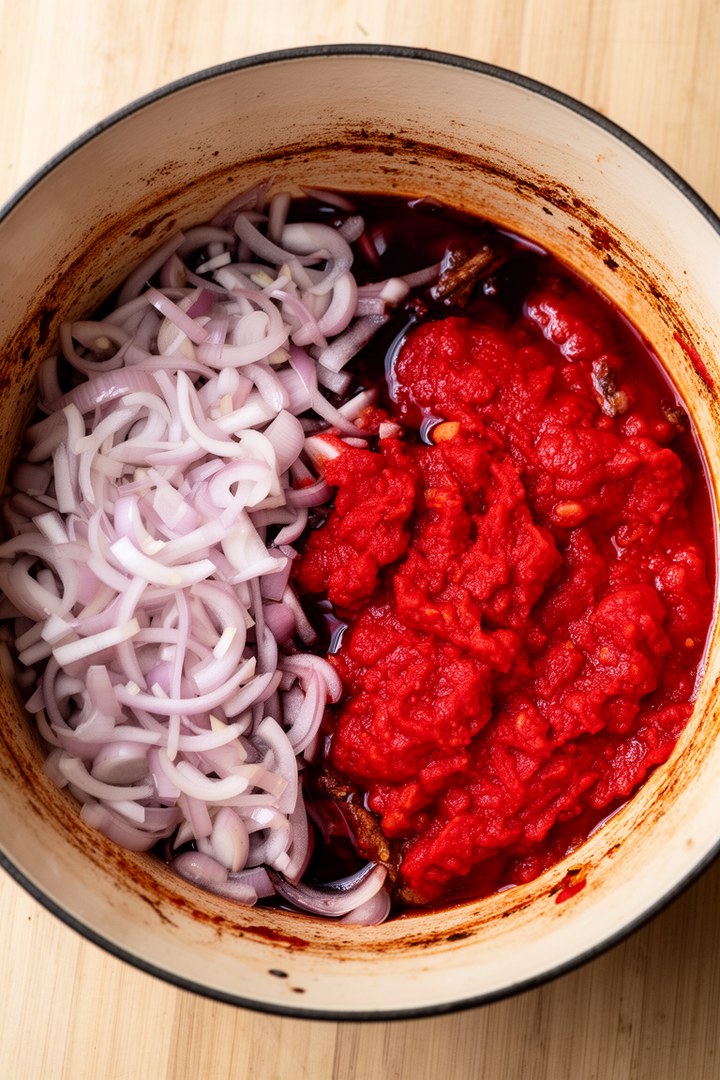
Remove the braciole and set aside. Reduce the heat to medium, add a chopped onion to the same pot, and cook 3 to 4 minutes until softened. Pour in the red wine and scrape the browned bits from the bottom of the pot — this is where the flavor lives. Add the crushed tomatoes, stir to combine, and bring to a gentle simmer. Return the braciole to the pot, nestle them snugly in the sauce, cover tightly, and reduce heat to low. Braise for 45 to 60 minutes, turning the rolls once halfway through. Check doneness with a fork: it should slide into the thickest part of the roll with no resistance. Time is a guide; texture is the signal.
What’s the Difference Between Beef and Veal Braciole?
Veal braciole is more delicate and cooks faster — 30 to 35 minutes of braising versus 45 to 60 for beef round. Veal has less connective tissue, tenderizes more quickly, and has a milder flavor that lets the filling come forward. Beef braciole is more widely available, costs significantly less, and produces a richer, more complex sauce from the longer braise. Both are legitimate — the choice comes down to budget and availability. If you use veal, watch the braising time closely. It overcooks and dries out faster than beef, and there’s no recovering an overcooked veal roll.
Cook’s Notes & Tips
- ¼ inch is the target: Thicker than that and the center won’t tenderize during braising. Use a meat mallet, not a rolling pin — rolling pins compress without thinning evenly. Work between two sheets of plastic wrap to prevent tearing.
- Dry the rolls before searing: Pat with paper towels immediately before they go in the pan. Any surface moisture causes steaming instead of browning. The pan should be visibly shimmering before the meat touches it.
- Don’t skip the twine: Toothpicks work for very small rolls but can’t hold a tight braise. Kitchen butcher’s twine is cheap and reusable. Remove it before slicing or serving — it can be easy to forget.
- Doneness is tactile, not timed: A fork or thin skewer should slide into the thickest roll with zero resistance. Start checking at 40 minutes. Thin rolls may be done; thick ones may need another 15 to 20 minutes.
- Use a Dutch oven if you have one: Even heat distribution matters during a long braise. A thin-bottomed pot creates hot spots that can scorch the sauce before the meat is fully tender.
How to Serve Braciole
Remove all the kitchen twine before bringing it to the table. Serve the braciole whole or sliced into thick rounds — each cross-section reveals the spiral of filling inside. Spoon the tomato braising sauce generously over the top. In the Italian-American tradition, the sauce is tossed with rigatoni, pappardelle, or penne and served as a first course; the braciole follows as the main. If you’re keeping it simpler, polenta, mashed potatoes, or a thick slice of crusty bread is all you need to make the most of the sauce. Finish with a simple bitter green salad — escarole, arugula, or radicchio — to cut through the richness.
Make-Ahead Instructions
Braciole is a textbook make-ahead dish. Like most braises, it tastes noticeably better the next day once the flavors have had time to settle. Cook completely, cool to room temperature, and refrigerate in the sauce in a covered container for up to 2 days. The fat will solidify on top overnight — skim it before reheating for a cleaner sauce. You can also prepare and tie the raw rolls up to 24 hours ahead and refrigerate them uncooked; sear and braise the day you plan to serve.
Storage & Reheating
Refrigerate braciole in the sauce for up to 3 days. Freeze for up to 3 months — always freeze with the sauce, not separately, or the meat will dry out. To reheat from refrigerated, warm covered over low heat on the stovetop with a splash of water or broth if the sauce has thickened. From frozen, thaw overnight in the refrigerator first, then reheat the same way. Avoid the microwave if possible — it heats unevenly and toughens the exterior of the rolls while the center stays cold.
About ¼ inch (6mm) is the target. This is thin enough to roll tightly and tenderize fully during braising, but thick enough that the meat won’t tear during rolling or fall apart in the pot. Pound between two sheets of plastic wrap using the flat side of a meat mallet, working from the center outward in overlapping strokes.
Almost always one of two reasons: the beef was too thick before rolling, or the braising time was too short. Braciole needs at least 45 minutes of covered, low-heat simmering to tenderize fully. Check with a fork — it should slide in with zero resistance. If it’s still tough at 45 minutes, give it another 15 to 20 minutes and check again. Time on the clock is not a reliable indicator; texture is.
Chopped toasted walnuts or blanched slivered almonds are the closest substitutes in texture and fat content. Raisins are a traditional Sicilian alternative — they add sweetness instead of crunch, which is a legitimate regional variation. If you skip nuts entirely, add an extra tablespoon of breadcrumbs to keep the filling from becoming too loose during rolling.
Yes, though the timing changes significantly. Chicken braciole is pounded and rolled the same way, but it braised for only 25 to 30 minutes — less than half the time of beef. Chicken overcooks quickly, so monitor carefully. The filling is the same; the technique is identical. The result is lighter and less rich than beef braciole, but it works well as a weeknight version.
Yes, but sear the rolls in a hot skillet first — 8 to 10 minutes total, all sides browned. The slow cooker cannot replicate the crust from a sear, and that browning contributes most of the dish’s depth. After searing, transfer to the slow cooker with the sauce and cook on LOW for 5 to 6 hours or HIGH for 3 to 4 hours. The braciole will be very tender; slice carefully as the meat will be softer than stovetop-braised.






Leave a Reply