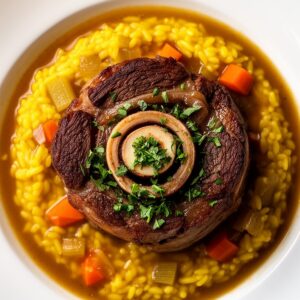
Osso Buco (Braised Veal Shanks)
Braised veal shanks with rich marrow, gremolata, and pan-seared crust. Deep flavor from slow cooking and bright lemon finish.
Ingredients
- 4 veal shanks, cross-cut 1½ to 2 inches (4 to 5 cm) thick, tied with kitchen twine around circumference
- 1 tsp salt
- ½ tsp black pepper
- 3 tbsp all-purpose flour for dredging
- 3 tbsp olive oil
- 1 medium onion, diced
- 1 medium carrot, diced
- 1 celery stalk, diced
- 3 cloves garlic, minced
- 1 tbsp tomato paste
- 1 cup dry white wine
- 2 cups chicken or veal stock
- 2 sprigs fresh thyme
- 1 bay leaf
For the Gremolata
- 2 tbsp lemon zest finely minced
- 2 cloves garlic, minced raw
- ¼ cup flat-leaf parsley, chopped
Instructions
- Pat the veal shanks completely dry with paper towels. Season generously with salt and pepper on all surfaces, including the cut faces and sides.
- Dredge each shank lightly in flour, shaking off excess — this helps the exterior brown and thickens the braising liquid slightly as it cooks.
- Heat olive oil in a Dutch oven over high heat until the oil shimmers and just begins to smoke. The pan must be very hot or the shanks will steam instead of sear.
- Working in batches to avoid crowding, add the veal shanks and sear 3 to 4 minutes per side, turning once, until deeply browned (almost caramelized) on both cut faces. Do not rush this step — a pale sear produces a weak braising liquid. Remove shanks and set aside on a plate.
- Reduce heat to medium. Add a little more oil if the pan is dry, then add the diced onion, carrot, and celery. Cook 5 to 7 minutes, stirring occasionally, until the vegetables are softened and beginning to brown at the edges.
- Add the minced garlic and cook 1 minute more until fragrant. Add the tomato paste and stir it into the vegetables for 1 minute until it darkens slightly and loses its raw taste.
- Pour in the white wine and use a wooden spoon to scrape up every browned bit from the bottom of the pot — this is where flavor lives. Let the wine reduce by half, about 3 minutes.
- Add the chicken or veal stock. The liquid should reach roughly halfway up the sides of the shanks, not cover them completely. If you have more stock than needed, save it — you may need to top up during braising.
- Return the seared shanks to the pot, nestling them into the liquid. Add the thyme sprigs and bay leaf. Bring the liquid to a gentle simmer over medium heat — do not boil.
- Cover the Dutch oven tightly with its lid (or parchment paper and foil if your lid doesn't seal well) and transfer to a 325°F (165°C) oven.
- Braise for 1½ to 2 hours, turning the shanks once at the halfway point (after 45 minutes). Check at 45 minutes — if the liquid level has dropped significantly, add a splash of stock to maintain the halfway mark.
- The veal is done when a fork slides into the thickest part of the meat with absolutely no resistance and the marrow inside the bone looks gelatinous and slightly translucent. If the meat still feels firm, return to the oven for 15-minute increments.
- While the osso buco finishes cooking, prepare the gremolata: mix the finely minced lemon zest, minced raw garlic, and chopped flat-leaf parsley together in a small bowl. Do not cook these ingredients — they must stay raw.
- Remove the osso buco from the oven. Discard the kitchen twine from each shank by cutting it away with a knife.
- Spoon the gremolata evenly over the shanks in the pot. Return to the oven for 5 minutes — just enough to warm the gremolata without cooking it. The gremolata should remain bright and slightly raw-tasting.
- To serve, place each veal shank on a portion of saffron risotto, polenta, or mashed potatoes. Spoon the braising sauce generously over the shanks and the starch. Provide a small marrow spoon or narrow teaspoon so guests can scoop the melted marrow from the center of the bone.
Notes
Tie each shank with kitchen twine to keep meat attached during braising. The sear is critical — 3-4 minutes per side on high heat builds the crust that flavors the entire dish. Braising liquid should reach halfway up the shanks, not cover them, or meat boils instead of braises. Add gremolata only in the last 5 minutes of cooking so the raw lemon zest and garlic stay sharp and bright.